
Famous for her books Mrs. Dalloway and To the Lighthouse, British author Virginia Woolf went down in history for her pioneering use of ‘stream of consciousness’ narratives and was named one of the most important modernist authors of the 20th Century.
Her writing style explored the inner thoughts and emotions of characters in a way that felt remarkably modern for the time, helping to influence generations of writers that followed. But she certainly has some quirks, and it’s those funny, lesser-known facts about the writer that we’re going to share with you today…
She physically made books
It wasn't just her story-writing that meant Virginia Woolf was an important part of literary history. Of course, her invention of a new style of writing called ‘stream of consciousness’ and her feminist themes made waves in the industry and changed the way that novels were written forever. But that's not all. As a teenager she had enjoyed bookbinding as a stress-relieving hobby and when she married Leonard, they decided to set up their own printing house. It was a true 'cottage industry' - the couple bought a hand-press and set it up on their dining room table. They named the business 'Hogarth Press' after their home and it was at the forefront of publishing books on psychoanalysis and translations of foreign works in the early 20th century.
The Hogarth Press would later become famous for publishing works by major literary figures including T.S. Eliot, Katherine Mansfield and E.M. Forster. Virginia and Leonard even hand-assembled some of the books themselves, carefully operating the press and binding pages together. It’s quite incredible to think that some of the most influential literature of the century began life on a dining room table surrounded by ink, paper and piles of manuscripts.
She was part of a hoax
Do you remember our blog post on 10 Silly Events in History? Well, one of those events was the boat hoax of 1910, where a Navy captain played a trick on his colleague by inviting the ‘Prince of Abyssinia’ to tour of the HMS Dreadnought. Virginia Woolf and five of her male friends dressed up in robes and were presented to the ship’s commander as dignitaries. They were given a tour of the famous British battleship and it was only later that the commander finally discovered it was a hoax, and that two members of his own family – his cousins – were in the Abyssinian group. What a jape!
To make the disguise more convincing, Woolf reportedly darkened her face with theatrical makeup and wore an elaborate costume complete with jewellery and a turban. The group even invented their own language made up of nonsense words and dramatic exclamations. Amazingly, the prank became national news and newspapers across Britain delighted in the embarrassment caused to the Royal Navy.

She wrote like an artist
Even though she didn’t enjoy contemporary art and was outraged by the attention artists received, Virginia Woolf aimed to create her novels in the same way that an artist paints a picture. She would write standing up at a tall desk, as if she was working at an easel. This allowed her to step back ‘to get a better look’, much like an artist appraising their painting while they’re working on it. From being only 11 years old, she experimented with different types of pens while she was writing, just like an artist would use a variety of brushes. She most liked using her mother’s pen, filled with purple ink. She claimed to enjoy the sensation of writing and holding the ‘perfect pen’ helped her words to flow onto the page.
Woolf was also known for being highly disciplined with her routine. She often wrote in the mornings when she felt her mind was clearest, carefully revising sentences over and over until they sounded exactly right. Friends described her as deeply thoughtful but also very funny, with a sharp sense of humour that often appeared in her letters and diaries.
Woolf kept detailed diaries throughout her life. Today, these journals give readers and historians a fascinating glimpse into her creative process, daily routines and thoughts about literature, society and fellow writers.
Her feet were her favourite mode of transport
It wasn’t just the fact that she couldn’t drive that led Virginia Woolf to be a keen walker. Her afternoons were spent rambling, sometimes up to eight miles at a time. Hills, ditches and barbed-wire fences couldn’t stop her; she’d scramble over them to continue her daily stroll. That’s not to say that she didn’t try to drive. She took lessons and bought a luxurious car but after driving it through a hedge she thought it would be better if she stuck to walking. The only time she went out in the car again was as passenger.
Virginia Woolf was known for taking long walks around London and the Sussex countryside. Themes of everyday life, fleeting conversations and changing weather frequently appeared in her novels and essays, leading many readers and biographers to connect her love of walking with her observational writing style.
She loved unusual conversations
Virginia Woolf was part of the Bloomsbury Group, a circle of writers, artists and intellectuals associated with progressive and unconventional ideas in the early 20th century. Members of the group frequently discussed literature, politics, philosophy and art, and aspects of Woolf’s social circle are often thought to have influenced characters and relationships in her fiction.
She had an unusual pet
Virginia and her husband had a pet marmoset monkey that they named Mitzi. Need we say anything more?? The unusual pet became one of the many quirky details associated with the Woolfs and their creative social circle. Even among the artistic and unconventional Bloomsbury Group, a pet monkey was still rather memorable. Woolf’s friends and fellow writers were certainly no strangers to eccentric personalities and unusual household stories.

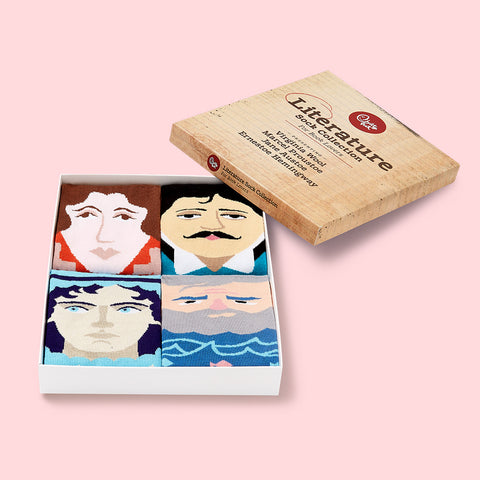
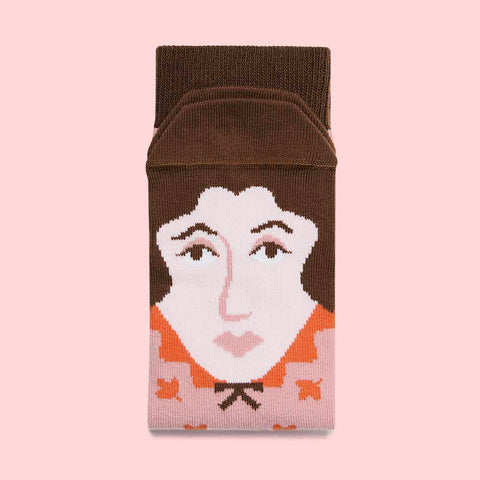
Love literature? Browse our collection of cheerful gifts inspired by authors.


I believe Woolf is more inspiring than anyone else in world
by Poppy Goodwin on June 30 2022 at 11:06 AM
I love my Virginia Wool(f) socks – my feet definitely have a creative feel to them when I wear them!
by Zoe Crompton on March 24 2020 at 05:03 PM